
MOTS-c Research: Mitochondria-Derived Peptide and Metabolic Signalling | Signal Labs
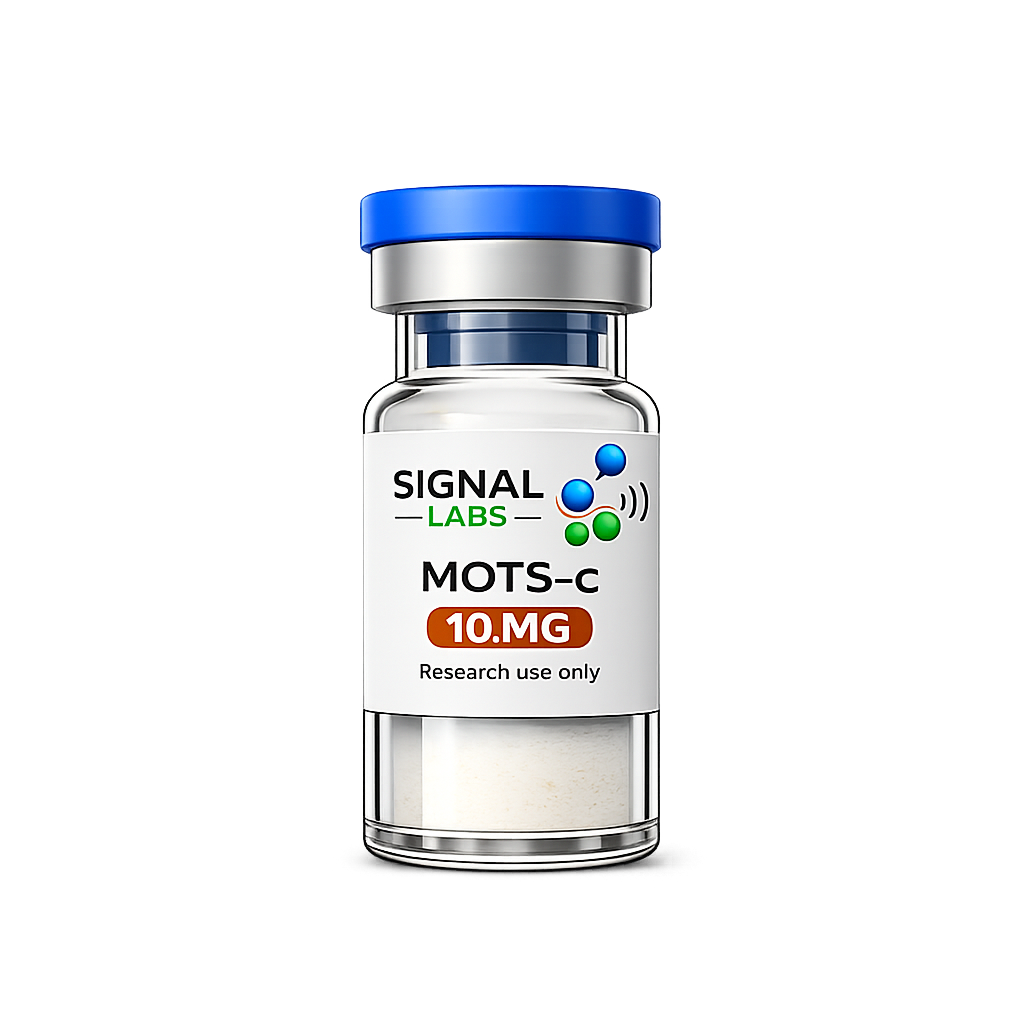
MOTS-c: Mitochondria-Derived Peptide Research and Metabolic Signalling
MOTS-c (Mitochondrial Open Reading Frame of the 12S rRNA-c) is a peptide encoded entirely within the mitochondrial genome, specifically within the 12S rRNA gene (MT-RNR1). Its discovery challenged the long-held assumption that the 37-gene mitochondrial genome encodes only respiratory chain proteins, tRNAs, and rRNAs. Identified by Lee et al. in 2015, MOTS-c represents a new class of bioactive molecules: mitochondria-derived peptides (MDPs).
Chemical and Molecular Data
| Property | Value |
|---|---|
| Molecular formula | C101H152N28O31S2 |
| Molecular weight | 2174.5 g/mol |
| CAS number | 1627580-64-6 |
| Sequence | MRWQEMGYIFYPRKLR |
| Amino acid count | 16 |
| Gene locus | 12S rRNA gene (MT-RNR1), mitochondrial genome |
| Purity | greater than or equal to 98% as verified by HPLC |
| Form | Lyophilised powder |
| Storage | -20 degrees C, protected from light and moisture |
| Reconstitution | Bacteriostatic water recommended |
MOTS-c: Mitochondria-Derived Signalling Peptide
Discovery and Genomic Context
MOTS-c is encoded within an alternative open reading frame of the 12S ribosomal RNA gene (MT-RNR1). MT-RNR1 is a structural RNA gene, not traditionally considered protein-coding. The discovery that it harbours an ORF encoding a bioactive peptide opened a new field of mitochondrial peptide biology. The 16-amino-acid sequence is translated within the mitochondrial matrix using the mitochondrial genetic code, then secreted into the cytoplasm and bloodstream where it functions as a circulating signalling molecule.
AMPK Pathway Activation
MOTS-c activates AMP-activated protein kinase (AMPK), the cell's primary energy sensor. AMPK activation promotes glucose uptake via GLUT4 translocation, fatty acid oxidation, mitochondrial biogenesis, and suppression of energy-consuming anabolic processes. AMPK is activated when the AMP/ATP ratio rises, indicating energy deficit.
Folate Cycle and AICAR Mechanism
Research has proposed that MOTS-c inhibits enzymes in folate-dependent one-carbon metabolism, leading to accumulation of AICAR (5-aminoimidazole-4-carboxamide ribonucleotide), a naturally occurring purine synthesis intermediate and direct pharmacological AMPK activator. This represents a mitochondria-to-nucleus signalling route, with mitochondria communicating their functional state to regulate nuclear gene expression via AICAR-AMPK signalling.
Nuclear Translocation Under Stress
Under conditions of metabolic stress including glucose deprivation, oxidative stress, and UV radiation, MOTS-c can translocate to the nucleus where it modulates stress-responsive gene expression. This non-AMPK pathway is an active area of investigation.
Age-Related Decline and Exercise Research
Circulating MOTS-c concentrations decline with advancing age in animal models and human studies, paralleling the well-documented decline in NAD+ levels. Exercise has been associated with increased MOTS-c secretion, positioning it as a potential mediator of exercise-induced metabolic benefits.
Research Applications
MOTS-c is used in AMPK pathway and energy sensing studies, mitochondrial communication research, metabolic regulation models, and cellular ageing biology.
MOTS-c research intersects with NAD+ (mitochondrial energy metabolism and ageing), SLU-PP-332 (ERR receptor activation downstream of AMPK/PGC-1alpha), 5-Amino-1MQ (NNMT inhibition and NAD+ precursor availability), and TB-500 (complementary cellular signalling research).
MOTS-c vs Other Mitochondria-Derived Peptides
| Peptide | Size | Gene locus | Primary mechanism | Key research area |
|---|---|---|---|---|
| MOTS-c | 16aa | MT-RNR1 (12S rRNA) | AMPK / folate cycle / AICAR | Metabolic regulation |
| Humanin | 21aa | MT-RNR2 (16S rRNA) | IGF-1R / STAT3 / FPRL2 | Neuroprotection |
| SHLP1-6 | 6 peptides | MT-RNR2 (16S rRNA) | Mitochondrial function | Metabolic and cell survival |
Age-Related MOTS-c Research
Research has documented age-related changes in circulating MOTS-c that parallel the well-established decline in NAD+ levels:
- Plasma MOTS-c concentrations in elderly human subjects have been reported significantly lower than in young adults in several cross-sectional studies
- In mouse models, MOTS-c levels in skeletal muscle decline substantially with age, correlating with reductions in AMPK activity and glucose uptake capacity
- Exercise training in animal models has been associated with increased MOTS-c secretion from skeletal muscle, proposing it as a potential exercise-induced mitokine
- The MOTS-c decline with age appears to mirror the decline in mitochondrial biogenesis capacity and AMPK sensitivity observed in ageing muscle
Frequently Asked Questions
How does MOTS-c activate AMPK through the folate cycle?
The proposed mechanism involves MOTS-c inhibiting enzymes in the folate-dependent one-carbon metabolism pathway, specifically methylenetetrahydrofolate dehydrogenase (MTHFD). This inhibition leads to accumulation of AICAR (5-aminoimidazole-4-carboxamide ribonucleotide) — a purine synthesis intermediate that directly activates AMPK by mimicking AMP. This represents an indirect AMPK activation mechanism distinct from energy depletion (which raises AMP:ATP ratio) or direct AMPK activators.
What is the significance of MOTS-c nuclear translocation?
Under metabolic stress conditions — including glucose deprivation, oxidative stress, and UV radiation — MOTS-c translocates from the cytoplasm to the nucleus. Once there, it has been shown to bind to regulatory regions of nuclear genes and modify stress-responsive gene expression. This non-AMPK function represents a direct mitochondria-to-nucleus communication pathway, where the mitochondria can influence nuclear transcription in response to stress signals.
How does MOTS-c research connect to NAD+ biology?
Both MOTS-c and NAD+ are studied in the context of mitochondrial energy metabolism and cellular ageing. MOTS-c activates AMPK, which in turn phosphorylates and activates PGC-1alpha — the master regulator of mitochondrial biogenesis. PGC-1alpha is also co-activated by SIRT1 in an NAD+-dependent manner. This creates a shared upstream convergence: both MOTS-c (via AMPK/PGC-1alpha) and NAD+ (via SIRT1/PGC-1alpha) regulate mitochondrial biogenesis through the same downstream co-activator.
Published Research References
For laboratory and analytical research purposes only. Not for human or veterinary use. No dosage or administration guidance is provided or implied.
Related research compounds: NAD+ | SLU-PP-332 | 5-Amino-1MQ | TB-500
MOTS-c Nuclear Translocation: The AMPK-Independent Mechanism
While AMPK activation via AICAR accumulation explains much of MOTS-c's metabolic biology, a separate mechanism has been identified that operates independently of AMPK: nuclear translocation of MOTS-c itself. Under cellular stress conditions — glucose deprivation, oxidative stress, UV radiation — MOTS-c translocates from the cytoplasm to the nucleus, where it functions as a transcriptional co-regulator.
Nuclear MOTS-c has been shown to interact with transcription factors and modulate gene expression in stress-response pathways including the antioxidant response element (ARE) pathway controlled by Nrf2. This nuclear function is independent of the AICAR/AMPK pathway — MOTS-c with mutations preventing ATIC inhibition (and therefore not generating AICAR) can still translocate to the nucleus and modulate gene expression under stress.
The nuclear translocation pathway provides a second mechanistic dimension to MOTS-c biology: a metabolic arm (AICAR/AMPK) operating under basal and exercise conditions, and a stress-response arm (nuclear translocation/Nrf2/ARE) operating under conditions of cellular damage or nutrient deprivation.
Exercise-Induced MOTS-c: The Mitokine Concept
Reynolds et al. (Nature Communications, 2021) published a landmark study identifying MOTS-c as an exercise-induced mitokine — a peptide released from skeletal muscle in response to exercise that acts systemically. The study demonstrated that plasma MOTS-c concentrations increase following acute exercise in humans, and that exogenous MOTS-c can replicate aspects of exercise-induced metabolic adaptation in mouse models.
This positions MOTS-c within the broader framework of exercise mimetics — compounds that activate molecular pathways engaged by physical exercise. The exercise mimetic concept is particularly relevant for research in ageing, where declining exercise capacity limits the ability to obtain exercise's metabolic and longevity benefits. MOTS-c, alongside SLU-PP-332 (ERR agonist) and AICAR (direct AMPK activator), represents a research tool for studying exercise-mimetic metabolic pathways.
Frequently Asked Questions
How does MOTS-c differ from other mitochondria-derived peptides?
MOTS-c is one of several mitochondria-derived peptides (MDPs) identified in recent years, alongside Humanin and the SHLP (small humanin-like peptide) family. All are encoded within the mitochondrial genome's small ribosomal RNA gene (MT-RNR1) in alternative reading frames. Humanin activates IGF-1R and gp130/STAT3 signalling with cytoprotective effects in neuronal models. MOTS-c is distinct in its primary AMPK activation mechanism and metabolic focus. The full complement of MDPs and their interactions remain an active research frontier.
What is the significance of the decline in MOTS-c with age?
Age-related decline in circulating MOTS-c (documented in both rodent models and human cross-sectional studies) parallels the decline in mitochondrial function, exercise capacity, and metabolic flexibility that characterise biological ageing. Whether declining MOTS-c is a cause of metabolic ageing or a consequence of declining mitochondrial health is an open research question. Exogenous MOTS-c administration in aged animal models is one experimental approach to addressing this question.
Browse all Signal Labs research peptides | Peptide storage guide | Reconstitution guide