
Ipamorelin Research: Growth Hormone Secretagogue Molecular Profile | Signal Labs
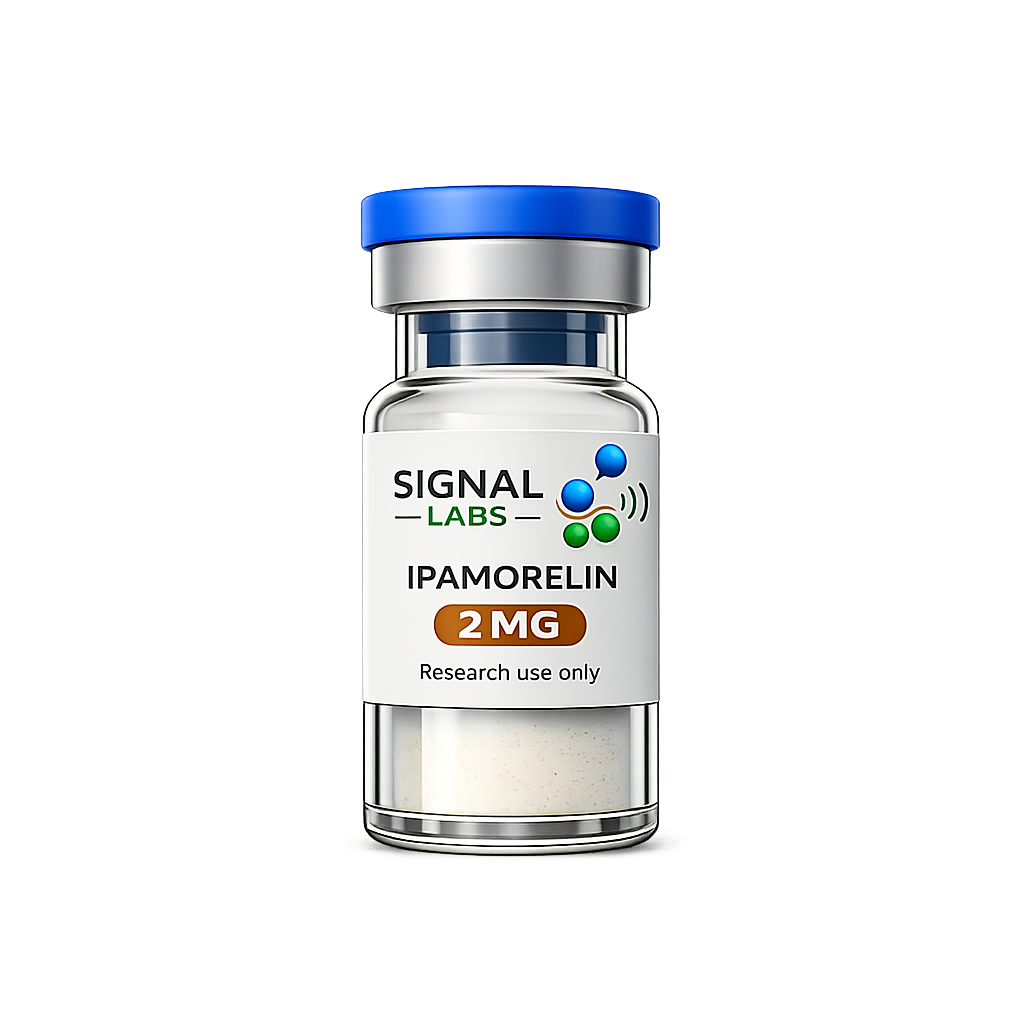
Ipamorelin: Selective GH Secretagogue Research Profile
Ipamorelin is a synthetic pentapeptide and selective growth hormone secretagogue receptor agonist. First described by Raun et al. in 1998, it rapidly became a widely used research tool for investigating GHS-R1a receptor pharmacology due to its exceptional receptor selectivity compared to earlier GHRP compounds.
Chemical and Molecular Data
| Property | Value |
|---|---|
| Molecular formula | C38H49N9O5 |
| Molecular weight | 711.85 g/mol |
| CAS number | 170851-70-4 |
| Sequence | Aib-His-D-2-Nal-D-Phe-Lys-NH2 |
| Amino acid count | 5 |
| Non-natural residues | Aib (pos. 1), D-2-Nal (pos. 3), D-Phe (pos. 4) |
| Purity | greater than or equal to 98% as verified by HPLC |
| Form | Lyophilised powder |
| Storage | -20 degrees C, protected from light and moisture |
| Reconstitution | Bacteriostatic water recommended |
Ipamorelin: GHS-R1a Selective Agonist Profile
Structural Design and Metabolic Stability
Ipamorelin incorporates three non-natural amino acid modifications that collectively contribute to its research utility.
Aib at position 1 (alpha-aminoisobutyric acid). Aib is a non-proteinogenic amino acid that resists enzymatic degradation by dipeptidyl peptidase IV (DPP-IV), the enzyme responsible for rapid inactivation of many regulatory peptides. Aib also tends to adopt alpha-helical conformations, influencing receptor binding geometry.
D-2-Naphthylalanine (D-2-Nal) at position 3. The D-configuration provides resistance to L-specific amino acid oxidases and many endopeptidases. The bulky naphthyl side chain contributes to GHS-R1a binding affinity.
D-Phenylalanine (D-Phe) at position 4. D-configuration for metabolic stability. This position in GH secretagogue peptides has been extensively studied in SAR research for its role in receptor selectivity.
C-terminal amidation (Lys-NH2). Prevents carboxypeptidase degradation, extending metabolic stability.
GHS-R1a Receptor Pharmacology
The growth hormone secretagogue receptor type 1a (GHS-R1a) is a Gq/11-coupled GPCR expressed predominantly in the hypothalamus and pituitary. Activation leads to phospholipase C activation, IP3-mediated calcium release, and PKC activation.
A defining characteristic of Ipamorelin versus earlier GHRPs (GHRP-2, GHRP-6, Hexarelin) is its selectivity. Functional assays have demonstrated that Ipamorelin activates GHS-R1a with minimal cross-reactivity at ACTH receptors, prolactin pathways, and aldosterone secretion pathways, making it a cleaner tool for isolated GHS-R1a biology research.
Growth Hormone Axis Research
In animal model studies, Ipamorelin has been used to investigate GH axis dynamics. It preserves physiological pulsatile GH secretion patterns, contrasting with CJC-1295 (With DAC), which produces sustained GH elevation, enabling comparison of pulsatile versus sustained stimulation paradigms. Preclinical rat model studies have also examined effects on tibial bone growth plate activity, a classic endpoint in GH axis research.
Research Applications
Ipamorelin is used in GHS-R1a binding and receptor pharmacology studies, GH axis signalling research, structure-activity relationship (SAR) studies of GH secretagogues, comparative receptor selectivity assays, and combined GH axis research alongside CJC-1295 (No DAC).
Storage and Handling
Store at -20 degrees C in a desiccated environment, protected from light and moisture. Reconstitute with bacteriostatic water. Non-natural amino acids contribute to excellent stability in lyophilised form. Avoid repeated freeze-thaw cycles.
Comparison: Ipamorelin vs Other GH Secretagogues
| Property | Ipamorelin | GHRP-2 | GHRP-6 | Hexarelin |
|---|---|---|---|---|
| Receptor | GHS-R1a | GHS-R1a | GHS-R1a | GHS-R1a |
| Amino acids | 5 | 6 | 6 | 6 |
| ACTH/cortisol release | Minimal | Moderate | Low | High |
| Prolactin release | Minimal | Moderate | Moderate | High |
| GH selectivity | High | Moderate | Moderate | Low |
| Non-natural residues | Aib, D-2-Nal, D-Phe | D-2-Nal, D-Phe | D-Trp, D-Phe | D-2-Nal, D-Phe |
| CAS | 170851-70-4 | 158861-67-7 | 87616-84-0 | 140703-51-1 |
Frequently Asked Questions
Why is Ipamorelin considered more selective than earlier GHRPs?
Earlier growth hormone releasing peptides such as GHRP-2 and Hexarelin activate GHS-R1a but also trigger release of ACTH (leading to cortisol elevation) and prolactin, which complicates their use as isolated GHS-R1a research tools. Ipamorelin demonstrates minimal activity at these secondary pathways in functional assay data, making it a cleaner pharmacological tool for studying GHS-R1a biology in isolation.
What is the difference between Ipamorelin and CJC-1295 in GH research?
Ipamorelin acts at GHS-R1a (the ghrelin receptor), activating GH release via IP3/Ca2+ and PKC pathways. CJC-1295 acts at GHRHR (the GHRH receptor), activating GH release via cAMP/PKA. These two receptors are complementary and synergistic — both are expressed on pituitary somatotrophs and their combined activation has been studied for additive GH release effects. This makes them frequently paired in dual-receptor GH axis research designs.
Does Ipamorelin bind albumin?
No. Ipamorelin has a short plasma half-life (approximately 2 hours) and does not incorporate a fatty acid or DAC group for albumin binding. This contrasts with CJC-1295 (With DAC), which achieves an approximately 8-day half-life through covalent albumin binding, and Semaglutide which achieves approximately 7 days through non-covalent fatty acid-albumin interaction.
What is the reconstitution protocol for Ipamorelin?
Reconstitute Ipamorelin lyophilised powder with bacteriostatic water. Store lyophilised at -20°C. Once reconstituted, store at 4°C and use within a short timeframe. Avoid repeated freeze-thaw cycles. The non-natural amino acids (Aib, D-forms) contribute to improved stability compared to native GHRP sequences.
Published Research References
For laboratory and analytical research purposes only. Not for human or veterinary use. No dosage or administration guidance is provided or implied.
Related research peptides: CJC-1295 (No DAC) | CJC-1295 (With DAC) | BPC-157 | Retatrutide
GHS-R1a Structure: The Ghrelin Receptor Architecture
GHS-R1a is a class A GPCR with seven transmembrane helices. Its crystal structure (Shiimura et al., Nature Communications, 2020) revealed that the orthosteric binding pocket is remarkably deep and enclosed — buried within the transmembrane bundle with limited extracellular access compared to many GPCRs. Ghrelin (and synthetic GHRPs including Ipamorelin) enter this pocket through a narrow vestibule formed by extracellular loops 2 and 3.
The key pharmacophore for GHS-R1a binding is the aromatic residue at position 3 of the peptide ligand: D-2-Naphthylalanine in Ipamorelin occupies a large hydrophobic cavity in the receptor that normally accommodates ghrelin's octanoyl chain. The D-configuration at the adjacent Ala1 positions this aromatic residue correctly — L-Ala1 rotates the D-2-Nal away from its optimal binding geometry, dramatically reducing affinity.
Ipamorelin Selectivity: Why It Matters for Research
The superior selectivity of Ipamorelin versus earlier GHRPs (GHRP-2, GHRP-6, Hexarelin) has been the subject of systematic pharmacological investigation. The key finding from Raun et al. (1998) was that Ipamorelin produces GH release equivalent to GHRP-6 but without measurable ACTH, cortisol, prolactin, or aldosterone stimulation at therapeutic concentrations.
This selectivity was subsequently attributed to Ipamorelin's inability to activate GHS-R1b (the truncated non-signalling isoform) and certain other GHRP-responsive receptors that mediate off-target ACTH effects. The molecular basis involves subtle differences in receptor selectivity conferred by Ipamorelin's Aib1, D-2-Nal3, D-Phe4 combination versus the His1-D-Trp2 of GHRP-6.
Research using Ipamorelin alongside GHRP-6 in parallel experiments allows direct measurement of the GH-to-ACTH selectivity ratio for each compound, providing a practical tool for quantifying GHS-R1a selectivity in cell and animal models.
Calcium Signalling and GH Exocytosis
GHS-R1a couples to Gq/11 to activate phospholipase C (PLCbeta), generating IP3 (inositol 1,4,5-trisphosphate) and diacylglycerol (DAG). IP3 binds IP3 receptors on the ER membrane, releasing stored calcium that raises cytosolic calcium from resting levels (~100 nM) to peak concentrations of 1-10 microM. This calcium transient triggers GH secretory granule fusion with the plasma membrane through a SNARE protein-dependent mechanism.
The calcium signal from GHS-R1a activation is distinct from the cAMP signal generated by GHRHR activation. Research using fura-2 or fluo-4 calcium imaging in pituitary cells can directly visualise the calcium transient produced by Ipamorelin versus CJC-1295 No DAC, demonstrating their distinct intracellular signalling modalities.
Frequently Asked Questions
How does Ipamorelin compare to native ghrelin as a GHS-R1a research tool?
Native ghrelin (28aa with N-octanoyl modification at Ser3) is the endogenous GHS-R1a agonist but is difficult to work with: it requires the octanoyl modification for activity (unacylated ghrelin does not activate GHS-R1a), it has a short plasma half-life, and the octanoylation is chemically unstable. Ipamorelin avoids these complications while recapitulating GHS-R1a pharmacology with equivalent potency and superior selectivity. Ipamorelin is the preferred synthetic GHS-R1a agonist for laboratory research.
What is the significance of GHS-R1a constitutive activity?
GHS-R1a shows approximately 50% constitutive activity in the absence of ligand — it signals basally without agonist. This constitutive activity, mediated by spontaneous receptor conformational equilibrium toward the active state, contributes to baseline GH pulsatility. Inverse agonists (compounds that suppress constitutive activity) reduce baseline GH release, while Ipamorelin as a full agonist maximises receptor activity above the constitutive baseline. Researchers studying GHS-R1a constitutive activity use Ipamorelin as the full agonist reference alongside GHS-R1a inverse agonists.
Browse all Signal Labs research peptides | Peptide storage guide | Reconstitution guide
Ipamorelin UK — Signal Labs supplies ipamorelin as part of a complete GH secretagogue research toolkit for UK laboratories. Researchers searching to buy peptides UK will find Signal Labs provides HPLC verified ipamorelin alongside CJC-1295 No DAC, GHRP-2, GHRP-6, and Hexarelin — all research peptides UK labs need for GH axis research.